Social LEAP Estimates Animal Poses (SLEAP)
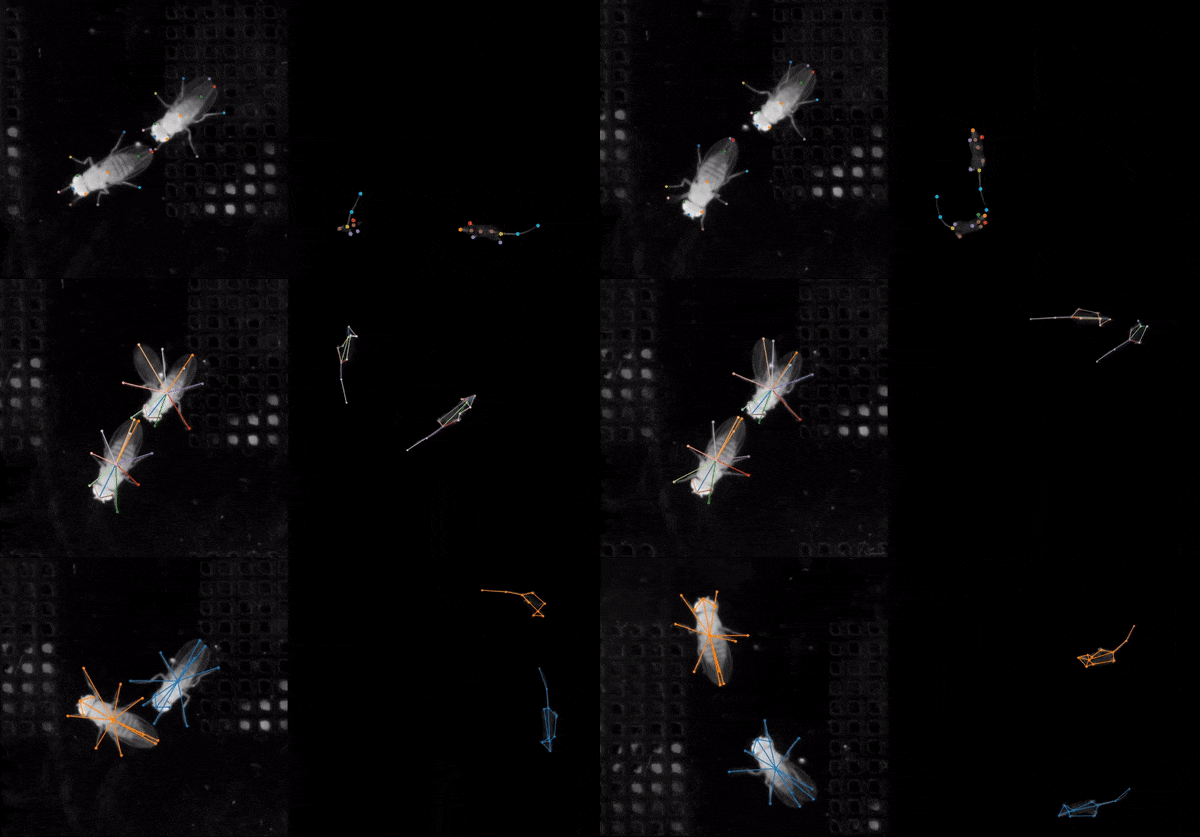





SLEAP is an open-source deep learning framework for multi-animal pose tracking (Pereira et al., Nature Methods, 2022). It provides an end-to-end workflow from labeling to trained models, with a purpose-built GUI for active learning and proofreading.
✨ Features
- Easy installation – One-line install with support for all major OSes
- Powerful GUI – Human-in-the-loop workflow for rapidly labeling large datasets
- Flexible models – Single and multi-animal pose estimation with top-down and bottom-up strategies
- Customizable architectures – Neural networks that deliver accurate predictions with very few labels
- Fast training – 15-60 mins on a single GPU for typical datasets
- Fast inference – Up to 600+ FPS batch processing, <10ms realtime latency
- Modern backends –
sleap-iofor data handling and PyTorch-basedsleap-nnfor training
Let's Get Some SLEAP! 🐭🐭
📚 Explore the Docs
-
Workflow Overview
End-to-end workflow with links to all resources.
-
Tutorial
Step-by-step guide from labeling to tracking.
-
Guides
Advanced workflows and best practices.
-
Notebooks
Jupyter notebooks for training, analysis, and more.
-
Learning
GUI, training options, skeleton design, and more.
-
Reference
CLI, datasets, and full API.
🚀 Get some SLEAP!
Quick start
Install uv first:
# macOS/Linux
curl -LsSf https://astral.sh/uv/install.sh | sh

# Windows
powershell -ExecutionPolicy ByPass -c "irm https://astral.sh/uv/install.ps1 | iex"
Then install SLEAP:
Launch the GUI:
Full installation instructions
Learn to SLEAP
- Learn step-by-step: Tutorial
- Learn more advanced usage: Guides and Notebooks
- Learn by watching: ABL:AOC 2023 Workshop and MIT CBMM Tutorial
- Learn by reading: Paper (Pereira et al., Nature Methods, 2022) and Review on behavioral quantification (Pereira et al., Nature Neuroscience, 2020)
- Learn from others: Discussions on Github
🔄 Coming from SLEAP 1.4 or earlier?
New in SLEAP v1.5+
SLEAP v1.5+ introduced major changes including UV-based installation, PyTorch backend via sleap-nn, and modular data workflows with sleap-io. Check out Migration Guide!
| SLEAP ≤ 1.4 | SLEAP 1.5+ |
|---|---|
| Conda installation | UV or pip installation |
| TensorFlow backend | PyTorch backend (sleap-nn) |
| Monolithic package | Modular: GUI + sleap-nn + sleap-io |
Legacy Documentation
If you are using SLEAP version 1.4.1 or earlier, please visit the legacy documentation.
Get Help
-
Help Page
Common issues and solutions. View Help
-
Report Issues
Found a bug? Create an issue
-
Discussions
Questions? Start a discussion
References
SLEAP is the successor to the single-animal pose estimation software LEAP (Pereira et al., Nature Methods, 2019). If you use SLEAP in your research, please cite:
T.D. Pereira, N. Tabris, A. Matsliah, D. M. Turner, J. Li, S. Ravindranath, E. S. Papadoyannis, E. Normand, D. S. Deutsch, Z. Y. Wang, G. C. McKenzie-Smith, C. C. Mitelut, M. D. Castro, J. D'Uva, M. Kislin, D. H. Sanes, S. D. Kocher, S. S-H, A. L. Falkner, J. W. Shaevitz, and M. Murthy. SLEAP: A deep learning system for multi-animal pose tracking. Nature Methods, 19(4), 2022.
BibTeX
@ARTICLE{Pereira2022sleap,
   title={SLEAP: A deep learning system for multi-animal pose tracking},
   author={Pereira, Talmo D and Tabris, Nathaniel and Matsliah, Arie and
      Turner, David M and Li, Junyu and Ravindranath, Shruthi and
      Papadoyannis, Eleni S and Normand, Edna and Deutsch, David S and
      Wang, Z. Yan and McKenzie-Smith, Grace C and Mitelut, Catalin C and
      Castro, Marielisa Diez and D'Uva, John and Kislin, Mikhail and
      Sanes, Dan H and Kocher, Sarah D and Samuel S-H and
      Falkner, Annegret L and Shaevitz, Joshua W and Murthy, Mala},
   journal={Nature Methods},
   volume={19},
   number={4},
   year={2022},
   publisher={Nature Publishing Group}
}
Contributors
SLEAP was created in the Murthy and Shaevitz labs at the Princeton Neuroscience Institute at Princeton University.
SLEAP is currently being developed and maintained in the Talmo Lab at the Salk Institute for Biological Studies, in collaboration with the Murthy and Shaevitz labs at Princeton University.
Contributors & Funding
Contributors.
- Talmo Pereira, Salk Institute for Biological Studies
- Liezl Maree, Salk Institute for Biological Studies
- Arlo Sheridan, Salk Institute for Biological Studies
- Arie Matsliah, Princeton Neuroscience Institute, Princeton University
- Nat Tabris, Princeton Neuroscience Institute, Princeton University
- David Turner, Research Computing and Princeton Neuroscience Institute, Princeton University
- Joshua Shaevitz, Physics and Lewis-Sigler Institute, Princeton University
- Mala Murthy, Princeton Neuroscience Institute, Princeton University
Funding
This work was made possible through our funding sources, including:
- NIH BRAIN Initiative R01 NS104899
- Princeton Innovation Accelerator Fund
License
SLEAP is released under a BSD 3-Clause Clear License.